
Table of Contents
ToggleThe Journey of Career Growth and Progression: A Path of Transformation
In the vast landscape of our lives, where dreams flutter on the horizon and ambitions pulse in our hearts, career growth and progression emerge as pivotal markers. They are not mere stepping stones on the path to success; they are dynamic, evolving experiences that shape who we are and who we are destined to become. From our first tentative steps into the workforce to the lofty heights of leadership, the twin forces of career growth and progression weave a narrative of transformation, resilience, and self-discovery.
This blog will explore career growth and career progression from various perspectives—personal, professional, and societal—each offering a unique lens through which to view our evolving roles in the professional world. Let’s delve into the heart of these intertwined concepts, all the while threading our way through the poetic cadence of ambition and perseverance.
The Modern Career and Its Progression
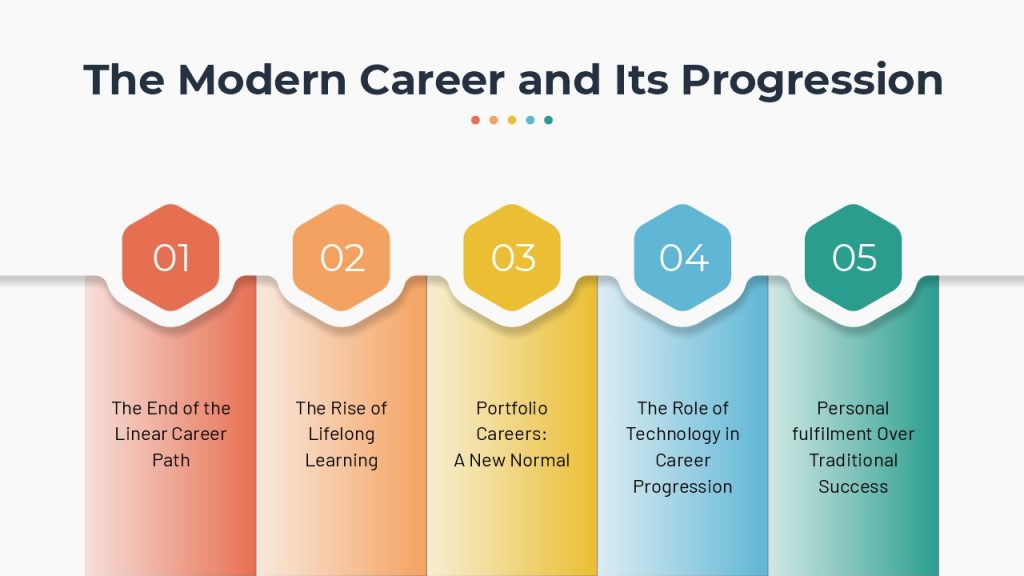
Presently, the concept of a career has evolved far beyond the traditional path of working for a single employer for decades before retiring. The modern career is dynamic, fluid, and often unpredictable, shaped by technological advancements, shifting industries, and the growing desire for personal fulfilment. Career progression, once measured solely by promotions and pay raises, now includes lateral moves, entrepreneurship, and lifelong learning. It’s no longer just about climbing the corporate ladder but about navigating a complex, ever-changing landscape.
Let’s explore how the modern career has transformed and how its progression looks vastly different from what we might have imagined a few decades ago.
The End of the Linear Career Path
In the past, a career often followed a relatively straight line. You started at an entry-level position, gradually moved up through the ranks, and eventually retired after a steady rise in responsibility and compensation. Today, however, the linear career path is increasingly rare. The notion that success is found only in moving up within a single organisation or industry has been replaced by a more flexible, adaptive approach.
The modern career often includes lateral shifts—changing roles, industries, or even starting fresh with entirely new skill sets. This flexibility allows individuals to pursue work that aligns more closely with their evolving interests and values, rather than feeling tethered to a single trajectory.
The Rise of Lifelong Learning
Another significant shift in the modern career landscape is the growing emphasis on continuous education. The rapid pace of technological change means that industries are constantly evolving, and the skills needed to succeed are in a state of flux. As a result, professionals must be committed to lifelong learning to stay relevant in their fields.
Career progression today often hinges on the ability to adapt and learn new skills, whether through formal education, online courses, or on-the-job training. This approach empowers individuals to take control of their own growth, making career progression more about personal initiative than simply waiting for promotions.
Portfolio Careers: A New Normal
One of the more recent trends in career progression is the rise of portfolio careers. Instead of working for a single employer, many individuals are now embracing multiple roles at once, such as freelancing, consulting, or running a side business. This multifaceted approach allows people to diversify their income streams and pursue passions that may not be traditionally lucrative on their own.
Portfolio careers also provide a level of autonomy and flexibility that was once uncommon. People can design careers that suit their lifestyles, balancing personal fulfilment with professional growth in ways that weren’t possible in the past. This shift reflects the growing desire for careers that are not just about financial success but also about purpose and passion.
The Role of Technology in Career Progression
Technology has played a pivotal role in reshaping modern careers. Remote work, automation, and the gig economy have all opened up new avenues for career progression that didn’t exist before. With the rise of remote work, employees are no longer limited by geography, and companies can hire talent from anywhere in the world. This globalisation has expanded opportunities for career growth in ways we never imagined.
Automation, meanwhile, has redefined many industries, creating new roles while making others obsolete. The need to stay ahead of technological advancements has made career progression more about adaptability and innovation than ever before.
Personal fulfilment Over Traditional Success
Perhaps the most profound change in the modern career is the shift from traditional markers of success—like promotions and paychecks—to personal fulfilment. Increasingly, people are prioritising work that brings meaning and aligns with their personal values. Career progression is no longer just about climbing the corporate ladder but about finding a path that resonates on a deeper level.
For many, this means choosing work that allows for a better work-life balance, or work that contributes to a cause they care about. In this sense, career progression today is about creating a life, not just a living.
The modern career is less a straight road and more a winding journey, with stops, detours, and unexpected turns along the way. Progression is no longer defined solely by upward mobility but by how individuals adapt, learn, and find fulfilment in their work. It’s an exciting time to redefine what career success looks like, as professionals are empowered to chart their own courses, embracing flexibility, lifelong learning, and personal passion.
What Is Career Growth?
Career growth is a deeply personal journey. It is the process by which we expand our skills, knowledge, and professional capabilities over time. This evolution occurs through deliberate learning, experience, and reflection. Unlike career progression, which often refers to upward mobility in terms of title or responsibility, career growth is more nuanced. It is about the development of the self, the sharpening of one’s abilities, and the cultivation of a mindset that embraces lifelong learning.
Imagine career growth as a garden that requires consistent nurturing. It’s not simply about reaching a specific goal but about cultivating your professional identity. Every new challenge, every project undertaken, and every skill acquired is akin to planting seeds in that garden. With time, dedication, and the right environment, those seeds blossom, enabling us to adapt to new roles and responsibilities as they arise.
The Emotional Landscape of Career Growth
Career growth is often accompanied by a range of emotions—anticipation, excitement, self-doubt, and even frustration. It’s a landscape full of peaks and valleys, where the highs are thrilling but the lows can feel overwhelming. Yet, it’s within these moments of uncertainty that the greatest growth occurs. In navigating challenges, we build resilience and perseverance, qualities that not only enhance our careers but also enrich our personal lives.
As we grow, we learn to ask ourselves deeper questions: Who am I becoming through this process? How do my experiences shape my professional identity? Career growth, in this sense, is a dance between action and introspection, between doing and being.
The Nature of Career Progression
Career progression, on the other hand, is the visible manifestation of our growth. It is the upward trajectory we experience in our professional lives—moving from one position to another, assuming greater responsibilities, and often receiving recognition in the form of promotions or salary increases. Career progression is the result of our consistent efforts and is typically measured in tangible terms like titles and roles.
In essence, career progression is the external acknowledgment of the internal work we’ve put into growing ourselves. It’s the reward for the seeds planted in the garden of career growth. However, career progression is not always linear. It can take unexpected turns, and sometimes, we may find ourselves plateauing or even stepping back before moving forward again.
The Importance of Patience in Career Progression
We often talk about career progression as though it’s a ladder we must continuously climb. But in reality, it’s more like a winding road, filled with moments of acceleration, pauses, and occasional detours. Patience becomes a critical companion on this journey. Progress is not always immediate, nor is it always obvious. But with every experience, whether it’s a promotion or a setback, we are progressing in ways that may not be visible at the moment.
Sometimes, career progression can mean lateral moves—stepping into roles that may not be “higher” in terms of hierarchy but that offer new experiences and opportunities for growth. These lateral shifts often provide the foundation for future advancement, allowing us to build a more robust set of skills and perspectives.
Career Growth vs. Career Progression: A Symbiotic Relationship
While career growth and career progression are distinct, they are also deeply interconnected. You cannot have sustainable career progression without growth, and growth without progression can leave one feeling stagnant. The two exist in a symbiotic relationship, each feeding the other in a continuous cycle of development.
As we grow in our careers—by learning new skills, taking on challenging projects, or deepening our expertise—we create the foundation for progression. Without growth, progression can feel empty, driven only by external recognition rather than personal fulfilment. Conversely, without progression, growth may feel unacknowledged, and we may struggle to see the tangible results of our efforts.
The Interplay Between Growth and Progression in the Workplace
In the workplace, fostering an environment that values both growth and progression is crucial for long-term employee satisfaction and retention. Employers who invest in their employees’ growth—by offering training, mentorship, and opportunities for skill development—are more likely to see those employees progress within the company. It’s a win-win scenario: the employee feels valued and fulfilled, while the organisation benefits from a more skilled and engaged workforce.
Companies that fail to recognise this symbiotic relationship risk creating a workforce that is either unmotivated (because there is no room for growth) or burnt out (because progression is pushed without the necessary growth to support it).
The Personal Perspective: Defining Success on Your Terms
From a personal perspective, career growth and progression are deeply tied to how we define success. And success, as we know, is a deeply individual concept. For some, career progression may mean rising to the highest levels of leadership, while for others, it may mean finding work-life balance, or mastering a particular skill set.
In today’s world, the traditional markers of career progression—titles, salary increases, and promotions—are no longer the only definitions of success. Success is subjective, and career growth allows us to redefine it on our own terms. Perhaps your definition of success is moving into a role that aligns with your personal values or transitioning into a new industry that excites you. These shifts, though not always recognised in conventional terms, represent profound career progression because they are rooted in personal growth.
Breaking Free from the Linear Model of Career Progression
For generations, we’ve been conditioned to see career progression as a ladder—one step at a time, always upward. But careers today are more akin to a lattice, with opportunities to grow in multiple directions. Moving sideways into a new role, or even stepping back to gain new experiences, can be just as valuable—if not more so—than climbing vertically.
This shift in thinking opens up a world of possibilities. No longer confined to a single path, we can now explore a variety of avenues for both growth and progression. In doing so, we create careers that are not only successful by traditional standards but also fulfilling on a personal level.
A Broader Perspective: The Role of Societal Expectations in Career Growth
Our career trajectories are not just shaped by personal ambition and professional development—they are also influenced by societal expectations. From a young age, we are often encouraged to follow certain paths or aim for specific milestones, like becoming a manager or earning a six-figure salary. These societal markers of success can often cloud our judgement, pushing us toward career progression that may not align with our personal growth.
It’s important to recognise that societal norms around career progression are constantly shifting. The gig economy, remote work, and the rise of entrepreneurship have all redefined what it means to have a successful career. Career growth in today’s world is not limited to corporate hierarchies. It might involve starting your own business, becoming a freelancer, or pivoting into an entirely new field.
The Changing Landscape of Career Progression
As our global workforce becomes more fluid and dynamic, traditional models of career progression are being replaced by more flexible, individualised paths. No longer are we tethered to the notion that success must look a certain way or follow a particular timeline. Career progression is now more about finding purpose, aligning work with values, and embracing the diverse ways in which our professional lives can evolve.
Society is gradually moving away from the rigid expectations that have long defined success. In their place, we see a greater emphasis on personal fulfilment, creativity, and the pursuit of work that aligns with one’s passions. This shift empowers individuals to take ownership of their careers, fostering a more authentic and meaningful approach to growth and progression.
Strategies for Enhancing Career Growth and Career Progression
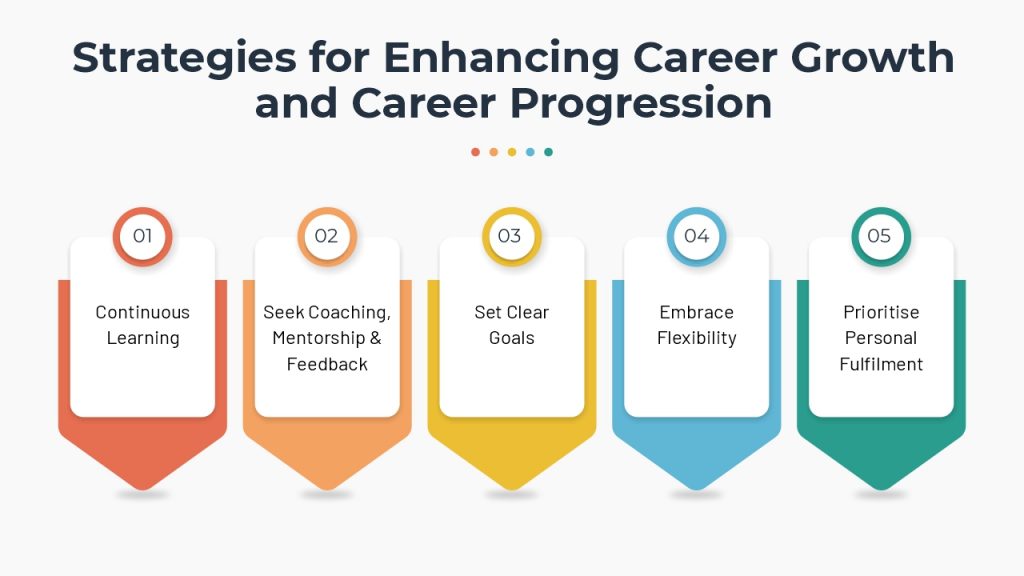
So, how can we actively cultivate both career growth and career progression? Below are some strategies that can help you navigate this journey:
1. Continuous Learning
In a world that never stops evolving, the key to growth lies in never stopping your learning journey. Invest in courses, certifications, and experiences that challenge you and expand your skill set. Learning is the fuel that powers both career growth and progression.
2. Seek Coaching, Mentorship and Feedback
Mentorship can provide invaluable insights into your career trajectory, offering guidance, support, and feedback. Mentors can help you see opportunities for growth and offer advice on how to progress within your industry.
3. Set Clear Goals
Setting both short-term and long-term goals helps you stay focused and intentional about your career path. Break these goals into actionable steps that align with both your personal values and professional ambitions.
4. Embrace Flexibility
Career growth and progression rarely follow a straight line. Be open to new experiences, lateral moves, or even temporary setbacks. Each experience, whether expected or not, contributes to your overall growth.
5. Prioritise Personal Fulfilment
Remember, career progression is not just about external success—it’s about finding fulfilment and purpose in your work. Stay true to your personal values, and don’t be afraid to redefine success on your own terms.
FAQs
Conclusion
Career growth and career progression are not endpoints—they are ongoing, ever-evolving journeys that continue throughout our lives. Like a river that flows and bends through unknown terrain, our careers take us on paths we may never have anticipated. But this journey, with its twists and turns, is what makes our professional lives rich, meaningful, and full of possibility.
The beauty of career growth lies in its endless potential. There is always more to learn, more to experience, and more ways to expand ourselves both personally and professionally. In the same breath, career progression offers us tangible milestones that give structure and direction to our ambitions. Together, they form a symbiotic relationship that nurtures our development and helps us realise our fullest potential.
By embracing both growth and progression, we move forward not only in our careers but also in life, becoming more skilled, more reflective, and more fulfilled with each step we take. Remember, this is not a race. Career success is deeply personal, and the path to it can—and should—look different for everyone. Whether you are moving swiftly up the corporate ladder or navigating a slower, more introspective journey, both growth and progression are always within your grasp.
The secret to a truly successful career lies in balancing these two elements and understanding that, just as in life, the journey is the destination. So, nurture your career like a garden, and let both growth and progression flourish in their own time.
