
Table of Contents
ToggleCareer and Development: A Tale of Growth in Career
Career development is not just a singular event or destination; it’s a journey, a constant evolution of learning, improvement, and adaptation. It’s about expanding not only your professional qualifications but also understanding your aspirations and goals. In today’s ever-changing job market, where the landscape shifts with technological advancements and global trends, developing a growth mindset is the key to sustained success. So, how can we navigate this ongoing journey? How do we foster growth in our career while staying true to our individual paths?
What is Employee Development?
Employee development is the quiet, steady pulse of an organisation’s growth. It is the art of nurturing, guiding, and elevating employees so that they can reach their full potential. But what does this concept truly encompass?
At its core, employee development refers to the continuous process of enhancing an employee’s skills, knowledge, and abilities. It is more than just job training—it’s about fostering a culture of learning, improvement, and self-discovery. It is a holistic approach aimed at enabling employees to reach their fullest potential. Like a gardener tending to a young sapling, the goal is to help employees flourish in their roles and beyond.
Development manifests in various forms. It could be through on-the-job training, where employees learn by doing, or via structured learning like workshops, seminars, or certifications. Mentorship, too, plays a critical role in development, offering a more personal and supportive way for employees to grow.
The beauty of employee development lies in its reciprocity. As employees grow, so too does the company. By investing in the growth of individuals, organisations cultivate a workforce that is more skilled, engaged, and motivated. In essence, employee development is a symbiotic process—one where both the individual and the organisation reap the rewards.
But beyond the tangible benefits of skill-building, employee development taps into something deeper. It speaks to the human desire for growth, progression, and purpose. When employees feel supported and see opportunities for development, they are more likely to stay loyal, bringing their best selves to work each day. Just like water and sunlight to a plant, employee development is essential for growth—both personal and professional.
The Interplay Between Career and Growth
A career is often seen as a straight road, paved with intentions of success and aspirations. But, in reality, it’s more of a winding path, where growth and development intersect at every turn. The interplay between career and growth is a delicate dance—a fusion of the personal and the professional. Each fuels the other, like roots feeding a tree, and as the tree branches out, so does the individual, reaching for new heights in their journey.
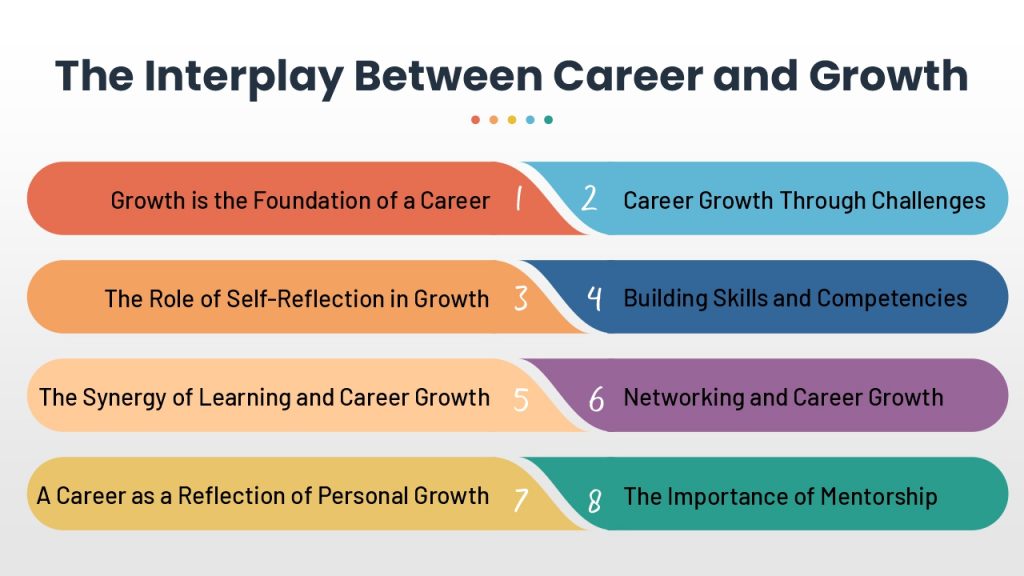
Growth is the Foundation of a Career
Growth is not merely about moving upward in a career; it’s about deepening your understanding, expanding your abilities, and nurturing your inner potential. At its core, career growth is about building upon the foundation you’ve created. Think of it as laying bricks: each new skill, each experience, and each challenge is a brick that makes the structure stronger. Without growth, the career may appear stagnant, like a river no longer flowing.
Growth demands curiosity—the kind that pulls you toward learning new things, embracing discomfort, and challenging what you already know. It is the process of seeking, failing, reflecting, and refining. Those who understand this rhythm will find that growth and career development are not separate entities, but intertwined threads of the same tapestry.
The Role of Self-Reflection in Growth
At the heart of career growth is self-reflection—a quiet, introspective process that allows you to assess where you are, where you want to go, and what might be holding you back. Self-reflection sharpens your focus, helping you distinguish between distractions and genuine opportunities for development. It’s in these moments of reflection where career goals are recalibrated, and paths may shift toward new, perhaps unexpected, directions.
Self-reflection requires honesty and vulnerability—qualities often hidden in the fast-paced world of career ambition. But in these vulnerable spaces, growth finds its true purpose, revealing insights that can lead to authentic success. This form of introspection helps align career aspirations with personal fulfilment, leading to a deeper, more meaningful progression.
Career Growth Through Challenges
Challenges and setbacks are inevitable in any career, but they are not to be feared. They are the catalysts for growth. When obstacles appear, they force us to reassess, reframe, and redirect our energy toward better outcomes. The struggles we face become opportunities to grow stronger, more adaptable, and more resilient.
In many ways, challenges are the most potent fertiliser for growth. They push us out of our comfort zones, stretching our capabilities. The beauty of career growth lies in how we respond to these challenges—whether we retreat in fear or rise to meet them with courage and determination.
The Synergy of Learning and Career Growth
Learning is the lifeblood of career development. It flows through every interaction, every new task, and every role you take on. Continuous learning sharpens the mind, enriches the soul, and keeps you competitive in a constantly changing world.
Growth doesn’t happen in a vacuum—it thrives in an environment where learning is valued and nurtured. Whether through formal education, mentorship, or self-directed exploration, each learning experience adds depth to your professional journey. And with every new piece of knowledge, your career growth gains momentum.
A Career as a Reflection of Personal Growth
Your career is more than just a sequence of jobs or roles—it is a reflection of your personal growth. Each stage of your career represents who you were at that time: your values, your ambitions, your strengths, and even your fears. As you grow as a person, so too does your career evolve.
Personal growth fuels career growth in profound ways. It influences how you approach problems, interact with others, and perceive success. As you become more attuned to your own development, you will find that your career path naturally aligns with your deeper sense of purpose and fulfilment.
Building Skills and Competencies
The foundation of career development lies in the consistent pursuit of new skills and knowledge. In an age where automation and AI are transforming industries, standing still is the same as falling behind. Developing relevant, in-demand skills not only keeps you competitive but opens up new opportunities. Whether it’s learning new software, acquiring leadership skills, or understanding emerging market trends, every new skill adds a layer to your professional persona.
Networking and Career Growth
We often hear the phrase, “It’s not what you know, but who you know.” While this shouldn’t undermine the value of your expertise, networking plays a pivotal role in career development. Connections within your industry can offer you insights, mentorship, and even job opportunities that you may not find elsewhere. Networking isn’t about gaining favours—it’s about building mutually beneficial relationships that enhance your growth and development.
The Importance of Mentorship
Mentorship is a bridge between where you are now and where you aspire to be. A mentor can offer wisdom, guidance, and advice based on their experiences, helping you avoid common pitfalls and providing support when you face challenges. This relationship can fast-track your development, offering an external perspective that helps illuminate paths you might not have considered.
The interplay between career and growth is an ongoing process, a dance that never truly ends. Both feed into each other, creating a harmonious rhythm that propels you forward in life. Career growth is not just about climbing higher; it is about growing inward and outward, becoming not only a better professional but a more rounded, fulfilled individual. And in that growth, you find the true essence of a career well-lived.
Career Development in Different Stages of Life
Career development isn’t a one-size-fits-all approach, and its strategies vary across different stages of life. Much like the seasons, our careers go through different stages, each one presenting its own set of opportunities, challenges, and transformations. These stages of career development mirror the journey of life itself—where we begin, how we grow, and ultimately, how we reflect on the paths we’ve taken. Understanding these stages can help us navigate our professional journey with more grace, purpose, and foresight.
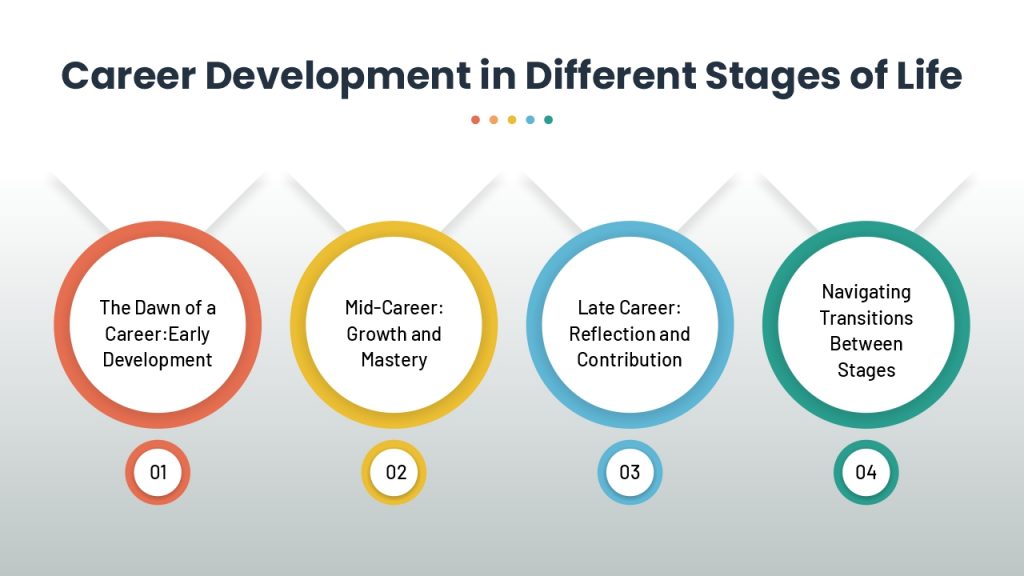
The Dawn of a Career: Early Development
In the early stages of our career, everything feels like the dawn of a new day—bright with possibility. We are eager to learn, explore, and prove ourselves. This phase is marked by curiosity and a thirst for knowledge, as we seek to find our place in the professional world. We ask ourselves questions: What am I passionate about? What skills do I need to succeed? How can I make an impact?
This is a time for experimentation and discovery. Early-career professionals often take on a variety of roles, learning not only about the work but also about themselves. This stage is about building a foundation, establishing credibility, and setting the course for future development. But it’s also a time to recognise that mistakes and missteps are part of the learning process.
Mid-Career: Growth and Mastery
As we move into the mid-career stage, the focus shifts from exploration to mastery. This is the period where we refine our skills, hone our expertise, and seek greater responsibility. The mid-career phase is often seen as the time of greatest professional growth—it is here that we push ourselves to climb higher, take on leadership roles, and contribute in meaningful ways.
But this stage can also bring with it a sense of stagnation or plateau. Many professionals find themselves asking: Is this it? What comes next? This phase can be both exciting and challenging, as we balance the need for stability with the desire for continued growth. It is a time to reassess our goals, set new ones, and remain open to new opportunities, even if they require stepping outside our comfort zone.
Late Career: Reflection and Contribution
In the later stages of a career, the focus often shifts from personal achievement to legacy. It is a time of reflection, where we look back on our journey and consider the impact we’ve made. This phase is less about climbing the career ladder and more about giving back—whether through mentorship, leadership, or simply sharing the knowledge we’ve gained over the years.
For some, this stage brings a sense of fulfilment, while for others, it may spark a desire for reinvention. Many professionals in their late careers seek new challenges, perhaps by shifting industries, taking on consultancy roles, or even pursuing creative passions that were set aside earlier in life. It’s a time of both reflection and rejuvenation, where the wisdom of experience meets the desire for meaningful contribution.
Navigating Transitions Between Stages
The transitions between these stages are not always smooth. Career changes, whether voluntary or not, can feel like stepping into the unknown. But these transitions are also opportunities for growth, allowing us to recalibrate our professional lives and realign them with our evolving sense of purpose.
Life events—such as starting a family, relocating, or dealing with health challenges—can also influence these transitions. Navigating these shifts with flexibility and resilience is key to maintaining momentum in our career development.
Career development is a lifelong journey, one that evolves alongside us as we move through the different stages of life. Each phase brings its own lessons, challenges, and triumphs. By embracing the different stages of career development, we not only grow professionally but also enrich our lives in ways that extend far beyond the workplace.
Embracing Change for Growth
Change is inevitable in any career, but rather than resisting it, embracing change can lead to unexpected growth. Whether it’s a job transition, moving into a different sector, or adapting to new technologies, change forces you to expand your boundaries, grow your skillset, and evolve as a professional.
The Psychological Aspect of Career Growth
In the race for success, we often overlook one of the most critical elements of career growth—the psychological aspect. While skills, knowledge, and opportunities are important, it is the mind, the will, and the spirit that propel us forward in our professional journey. The psychology behind career growth is a subtle force, but it is one that shapes how we perceive ourselves, our abilities, and the world around us.
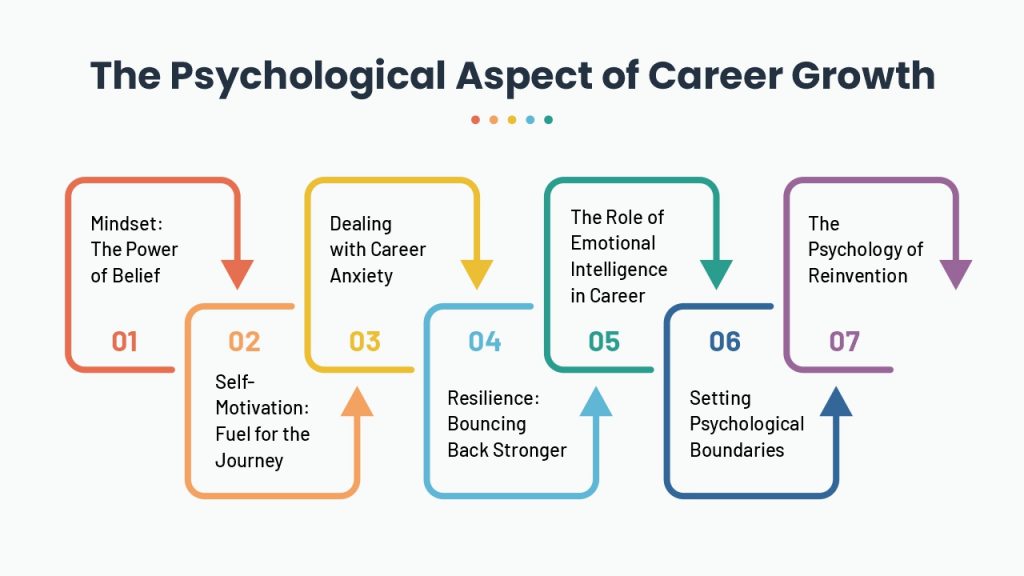
Mindset: The Power of Belief
At the heart of career growth lies our mindset—the lens through which we view the world and our place within it. A growth mindset, as defined by psychologist Carol Dweck, is the belief that our abilities can be developed through dedication and hard work. This belief becomes the cornerstone of professional success.
Those with a growth mindset see challenges as opportunities, not roadblocks. They understand that failure is not the end but a stepping stone to improvement. This mental flexibility allows them to take risks, embrace uncertainty, and persevere through difficulties, all of which are essential for long-term career growth.
Self-Motivation: Fuel for the Journey
While external factors like promotions or recognition can provide a boost, the most sustainable form of motivation comes from within. Self-motivation is the inner fire that pushes you to continue striving for better, even when the path is steep or unclear.
Career growth requires a deep well of motivation because the journey is rarely linear. There will be setbacks, delays, and moments of doubt. But those who can tap into their intrinsic motivation—whether it’s a desire to learn, achieve, or make an impact—will find the energy to keep moving forward.
Dealing with Career Anxiety
Acknowledging and managing these anxieties is crucial for sustainable career growth. Anxiety, in this context, can feel like a shadow that looms over even the brightest successes. Fear of failure, imposter syndrome, or the pressure of stepping into unfamiliar roles can lead to self-doubt. However, recognising that anxiety is a natural part of growth is the first step toward overcoming it.
Anxiety can often be managed through small but effective practices, such as mindfulness, stress management techniques, or seeking the support of mentors and peers. It’s important to remember that anxiety is not a sign of weakness but a signal that you’re stepping outside your comfort zone—a necessary place for real growth. By leaning into discomfort, rather than avoiding it, you give yourself the permission to stretch, learn, and expand.
Resilience: Bouncing Back Stronger
Resilience is another vital psychological trait that fuels career growth. In a world where the path to success is rarely straightforward, resilience is what keeps you moving forward despite setbacks. It’s the ability to bounce back after failure, to adapt to change, and to continue striving even when the outcome is uncertain.
Building resilience doesn’t happen overnight; it’s cultivated through experience and the mindset that challenges are temporary and surmountable. Each setback becomes an opportunity to learn, to reframe failures as lessons rather than defeats. Resilience acts as a protective layer against the emotional toll of a demanding career, allowing you to maintain focus and motivation even when times are tough.
The Role of Emotional Intelligence in Career Growth
Emotional intelligence (EI) plays an increasingly recognised role in career success. It’s not just about what you know or how well you perform technically; it’s also about how you manage relationships, handle conflict, and navigate the emotional complexities of the workplace.
High emotional intelligence allows for better communication, empathy, and collaboration, all of which are crucial for career growth, especially in leadership roles. By being attuned to your own emotions and the emotions of others, you can foster more meaningful connections and create a work environment that encourages mutual respect and growth.
Setting Psychological Boundaries
Career growth often comes with increased responsibilities, which can sometimes lead to burnout if not managed properly. Knowing when to set psychological and emotional boundaries is key to maintaining long-term growth without sacrificing personal well-being.
Setting boundaries means understanding your limits—knowing when to say no, when to take a step back, and when to prioritise self-care. This is not only important for your mental health but also for sustaining the energy and creativity needed for career progression. Healthy boundaries create space for both professional achievements and personal fulfilment, ensuring that growth is holistic and balanced.
The Psychology of Reinvention
One of the most exciting aspects of career growth is the possibility of reinvention. As people grow and change, so too do their interests, skills, and values. The ability to pivot in your career—whether by changing industries, taking on new roles, or even starting a completely new path—is a testament to psychological flexibility and openness to growth.
Reinvention requires letting go of the fear of judgement or failure and embracing the unknown. It’s a psychological leap, one that asks you to trust in your ability to learn, adapt, and succeed in unfamiliar territory. This mental courage is often what separates those who remain stagnant from those who continue to thrive in new and unexpected ways.
While career growth is often measured by external factors like promotions or salary increases, the real engine driving it is the mind. The psychological aspect of career growth—our mindset, motivation, resilience, and emotional intelligence—acts as the invisible hand that guides us toward success. By nurturing these internal forces, we create a fertile ground for not only professional achievements but also personal fulfilment.
In the end, a career is more than just a series of steps up a corporate ladder; it is a reflection of who we are, shaped by our thoughts, emotions, and mental strength. Understanding the psychological aspect of career growth unlocks the potential for a more meaningful, well-rounded professional journey.
The Role of Employers in Career Development
While personal efforts in development are essential, the role of employers cannot be understated. Companies that invest in their employees’ growth through training programs, learning opportunities, and clear career progression paths tend to have more engaged, loyal, and productive workforces.
Learning and Development Programs
Corporate learning and development programs are crucial for helping employees grow within their roles and prepare for future challenges. These initiatives are tailored to align with both individual goals and organisational needs, creating a win-win scenario where both the employee and the company benefit.
Overcoming Career Growth Plateaus
At times, even with your best efforts, you might hit a plateau in your career. It’s important to recognise these periods as temporary, using them as opportunities to reassess your goals, acquire new skills, or seek new challenges. Career growth doesn’t always follow a linear path; sometimes, lateral moves or taking a break can lead to greater growth in the long term.
The Importance of Setting Career Goals
One of the most effective ways to ensure continuous career growth is to set clear, achievable goals. These goals should not only be about promotions or salary increases but also about personal fulfilment, learning new skills, and becoming a better version of yourself. Break down long-term aspirations into smaller, actionable steps, and celebrate your progress along the way.
The Future of Career Development
FAQs
Conclusion
Career development is not a destination but a continuous process. It requires dedication, introspection, and the willingness to evolve. Growth in your career is not only about climbing the corporate ladder but about becoming a more skilled, fulfilled, and well-rounded professional.
