
Table of Contents
ToggleThe Art and Science of Decision Making: Building Skills for Life and Leadership

In every corner of life, decisions await us like crossroads, inviting us to choose a path. Some decisions are small and swift, like deciding what to eat for lunch, while others are complex and pivotal, like choosing a career or making business choices. In both instances, one’s decision making skills serve as a compass, guiding choices that shape life’s outcomes. But what truly defines good decision making, and how can we refine it? Let’s explore this craft, merging art and science to uncover how decision making models and techniques can guide us to wise choices.
What Is Decision Making?
Decision making is the process of choosing between alternatives, determining the best course of action based on goals, values, and available information. In both personal and professional settings, the decisions we make impact our trajectory, our relationships, and our overall well-being.
Why Decision Making Skills Matter
Effective decision making can improve productivity, foster stronger relationships, and help individuals navigate complex challenges. Skilled decision making reduces indecisiveness and empowers people to act confidently, leading to more satisfying outcomes in both personal and professional realms.
Understanding Decision Making Models
Decision making models provide a structured framework for making choices. These models serve as guides, helping us organise information, weigh options, and reach conclusions logically or intuitively. Structured approaches are especially valuable when navigating complicated decisions, as they prevent us from being overwhelmed by options.
Types of Decision Making Models
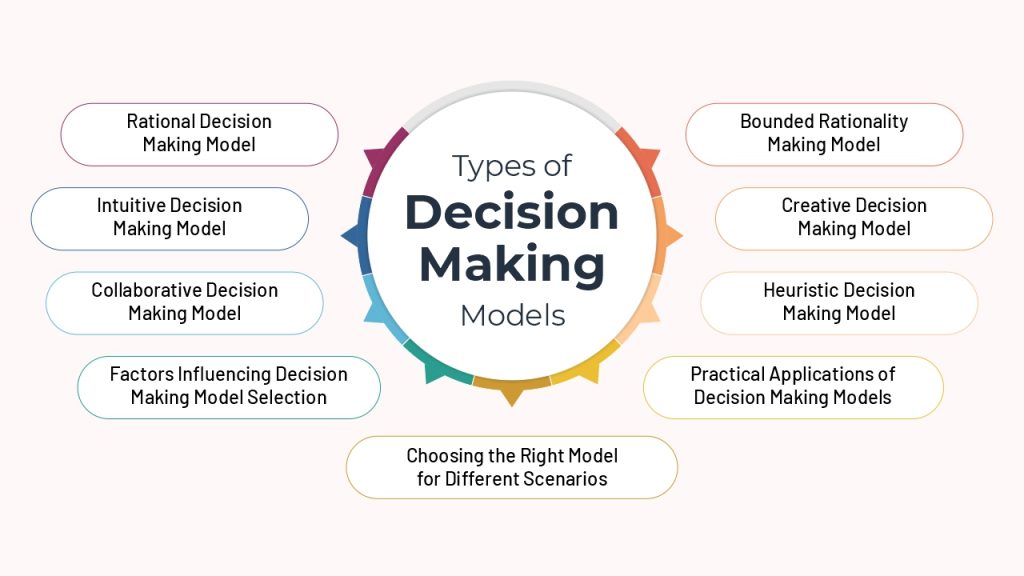
Decision making models come in various forms, each suitable for specific situations. Let’s explore some key types.
Rational Decision Making Model
The rational decision making model is highly analytical and systematic, requiring thorough evaluation of each option based on a series of steps. This model is especially useful in business when logic is prioritised over intuition. For example, a company considering expanding into a new market would analyse data, forecast potential outcomes, and evaluate risks before making a decision. It’s a meticulous approach but works well when time and resources allow for it.
Bounded Rationality Model
The bounded rationality model recognises that decision makers often face limitations such as time constraints and information gaps. Instead of searching for the perfect decision, they settle for one that meets acceptable criteria. This model is often seen in scenarios with restricted resources, like when startups make product choices without exhaustive data or when a public official makes policy decisions based on limited information.
Intuitive Decision Making Model
In fast-paced environments, the intuitive decision making model allows decisions to be made swiftly, relying on gut instincts and experience rather than detailed analysis. For instance, a seasoned ER doctor may make life-saving decisions based on intuition and years of medical practice rather than a lengthy analytical process. This model works well when quick judgement is crucial, though it carries more risk in unfamiliar situations.
Creative Decision Making Model
The creative decision making model encourages exploring innovative solutions, often blending traditional ideas with new approaches. This model is valuable in fields like advertising, where brainstorming sessions yield unique campaign ideas. For example, a creative director may need to develop an advertisement that breaks norms to stand out. The creative decision making model enables thinking outside the box, fostering innovation.
Collaborative Decision Making Model
The collaborative decision making model is ideal when teamwork and diverse input are essential. This model draws on the strengths and perspectives of multiple people to create a well-rounded decision. It’s commonly used in corporate environments where team synergy can lead to better solutions. For example, a company planning a large project might gather department heads to discuss their input, leading to a more holistic strategy.
Heuristic Decision Making Model
Heuristic models rely on mental shortcuts to make quick, efficient decisions. This method is often used in everyday decisions, like choosing a route home based on which seems least crowded. Though efficient, it may lead to oversights, as it’s more about convenience than thorough analysis. Heuristic decision making is especially useful when time is short and decisions are relatively low-stakes.
Each decision making model comes with its advantages and drawbacks. The rational model is comprehensive but can be time-consuming, whereas the heuristic model is fast but potentially prone to errors. Choosing the right model depends on balancing the need for detail with the need for speed.
Factors Influencing Decision Making Model Selection
Choosing the right model depends on factors like the complexity of the decision, time availability, and personal or organisational preferences. For instance, in high-stakes decisions where accuracy is essential, the rational model may be more appropriate. Conversely, when speed is the primary concern, the heuristic or intuitive model may be preferred.
Practical Applications of Decision Making Models
Different decision making models serve various industries and situations. In healthcare, intuitive decision making is crucial for quick action, while in finance, a rational approach is often required for risk management. Understanding these distinctions can help decision makers apply the most suitable model to their specific field.
In business, companies often blend different decision making models. For example, a marketing team may use the creative model to brainstorm campaigns but then apply the rational model to assess which ideas have the highest potential. In education, teachers may rely on heuristic decision making models for classroom management but collaborate when designing curriculum changes.
Choosing the Right Model for Different Scenarios
To choose the best model, it’s important to consider the unique demands of each scenario. For urgent, high-pressure decisions, an intuitive model might be best. For strategic planning with significant resources, a rational approach may yield better results. Matching the model to the situation can improve both decision quality and efficiency.
Each decision making model has its strengths and potential limitations. By understanding these different models, individuals and teams can make better choices, adapting their approach to the unique needs of each situation. Decision making is as much an art as it is a science, and using the right model can make a substantial difference.
Key Elements of Strong Decision Making Skills
Decision making is an essential skill that influences every aspect of life, from personal choices to professional paths. Strong decision making skills are more than just choosing between options; they involve careful consideration, analysis, and confidence. Here are the key elements that contribute to making sound and effective decisions.
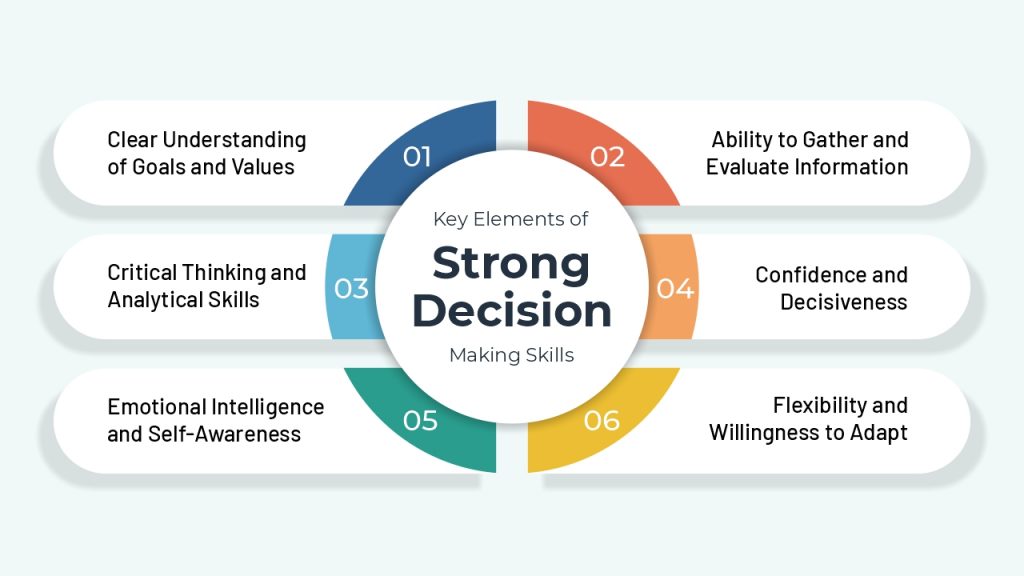
1. Clear Understanding of Goals and Values
Strong decision makers have a clear understanding of their objectives and values. Knowing what you truly want—whether it’s in your career, relationships, or personal growth—serves as a guiding compass. This clarity helps filter out irrelevant options and focus on choices that align with long-term goals.
2. Ability to Gather and Evaluate Information
Effective decision making requires the ability to collect relevant information and assess it objectively. This involves considering both factual data and potential consequences. Strong decision makers are skilled researchers, knowing where to find reliable sources, and they’re able to weigh the pros and cons of each option.
3. Critical Thinking and Analytical Skills
Being able to analyze information critically is crucial. Good decision makers don’t just look at surface-level details; they dig deeper to understand the implications of each choice. This analytical skill helps them make more accurate predictions about outcomes, ultimately leading to better decisions.
4. Emotional Intelligence and Self-Awareness
Emotional intelligence (EI) is often underestimated in decision making but plays a huge role. EI involves recognising and managing your own emotions as well as understanding others’ perspectives. Decision makers with high EI are less likely to be swayed by impulsive feelings and more likely to consider how their choices will impact others.
5. Confidence and Decisiveness
Confidence is the backbone of strong decision making. Indecisiveness can lead to missed opportunities, so having the courage to make a choice—and stand by it—is vital. Even if a decision turns out to be imperfect, confident decision makers are better equipped to learn from their mistakes and move forward.
6. Flexibility and Willingness to Adapt
Flexibility is a valuable trait in decision making, as unexpected changes often require adjustments. Effective decision makers stay open-minded and can adapt their choices if new information arises or circumstances shift. This adaptability helps them remain resilient in the face of uncertainty.
Strong decision making skills combine clarity, analytical ability, emotional intelligence, confidence, and flexibility. By developing these elements, anyone can enhance their ability to make choices that lead to better outcomes in both personal and professional life.
Factors Influencing Decision Making
The decisions we make aren’t made in a vacuum; they are influenced by a complex mix of factors that shape our choices. From internal beliefs to external pressures, here are the key factors that play a role in decision making.
1. Personal Values and Beliefs
One of the most powerful influencers of decision making is an individual’s core values and beliefs. These are often shaped by upbringing, culture, and personal experiences. Decisions that align with one’s values tend to feel more authentic, while choices that go against these beliefs often cause discomfort.
2. Emotions and Moods
Our emotional state can significantly affect decision making. For example, when we’re feeling anxious or stressed, we might make more conservative choices. Conversely, when feeling optimistic or excited, we might take on more risks. Being aware of emotions and managing them effectively is crucial for making balanced decisions.
3. Cognitive Biases
Cognitive biases, like confirmation bias or overconfidence, can skew judgement. These mental shortcuts influence how we process information, sometimes leading us to ignore contrary evidence or overestimate our abilities. Awareness of these biases can help mitigate their impact and lead to more objective decisions.
4. Social and Peer Influences
Humans are social creatures, and the people around us often affect our choices. Family, friends, colleagues, and society as a whole can all shape our perspectives. Decisions made in group settings, for instance, may be swayed by groupthink or peer pressure.
5. Available Information and Resources
The quality and amount of information at hand greatly influence decision making. With more accurate data and resources, decisions tend to be more informed. Conversely, limited information can lead to uncertainty and, sometimes, riskier choices.
6. Risk Tolerance
Individuals have different levels of risk tolerance, which influences how they approach decisions. Some people are naturally risk-averse, preferring safer options, while others are more open to taking risks, which may lead to bolder and potentially more rewarding choices.
Understanding these factors—values, emotions, biases, social influences, information, and risk tolerance—can help individuals make more informed and thoughtful decisions. Awareness of what influences our choices allows for greater control over the decision making process.
Common Decision Making Challenges
Decision making can be complex, especially when certain obstacles get in the way. Recognising these common challenges is the first step to overcoming them and making more effective choices.
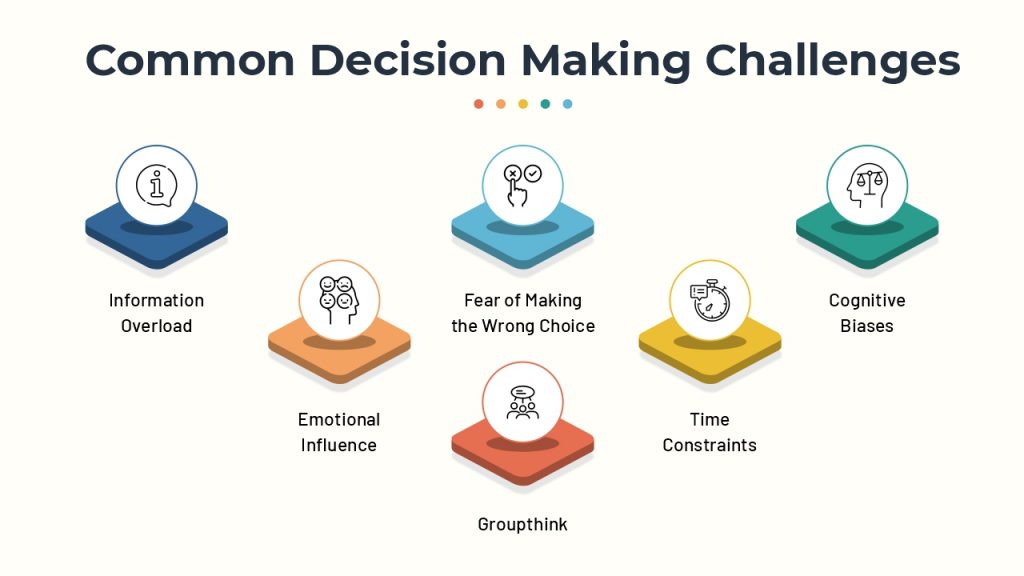
1. Information Overload
In today’s information age, we often face an overwhelming amount of data. This abundance of information can make it difficult to sift through what’s relevant, leading to confusion and analysis paralysis. Effective decision makers know how to prioritise and focus on key information.
2. Fear of Making the Wrong Choice
The fear of failure or making a poor choice can be paralysing. This fear often leads to procrastination or avoidance, delaying important decisions. Overcoming this challenge involves accepting that some risk is inevitable and viewing mistakes as learning opportunities.
3. Cognitive Biases
Biases, such as confirmation bias or sunk-cost fallacy, can cloud judgement and skew decisions. Confirmation bias, for example, leads people to favour information that supports their beliefs, while ignoring contradictory data. Recognising and managing these biases is essential for objective decision making.
4. Groupthink
In group settings, the desire for harmony can sometimes suppress individual opinions, leading to groupthink. When people avoid dissenting, they may end up agreeing with suboptimal choices. Encouraging open dialogue and valuing diverse perspectives can help avoid this pitfall.
5. Emotional Influence
Emotions are powerful influencers that can lead to hasty or overly cautious decisions. For example, anger can lead to impulsive choices, while fear may cause avoidance. Developing emotional intelligence helps in managing emotions and making more balanced decisions.
6. Time Constraints
Sometimes, decisions need to be made quickly, leaving little room for thorough analysis. These time constraints can lead to hasty choices, where only limited options are considered. Practising decision making under pressure can help improve responses in time-sensitive situations.
By recognising challenges such as information overload, fear of failure, biases, groupthink, emotional influence, and time constraints, individuals can take steps to address and overcome them. With awareness and preparation, decision making can become a smoother, more confident process.
The Role of Emotional Intelligence in Decision Making
Emotional intelligence (EQ) is invaluable in decision making. By recognising and managing emotions, individuals can approach choices more calmly and objectively, leading to wiser decisions. High EQ helps in understanding one’s own emotions, controlling impulsive reactions, and fostering empathy for others involved in the decision.
The Importance of Flexibility and Adaptability
Good decision making also requires the ability to adapt when circumstances change. In a dynamic world, adaptability allows individuals to pivot when necessary, re-evaluating previous choices and adjusting as needed without rigidly adhering to past decisions.
Decision Making in Leadership
Leaders are constantly called to make decisions that affect their teams and organisations. Strong decision making skills are essential for leadership, as they foster trust, drive productivity, and align team members with organisational goals. Leaders must balance data-driven decisions with empathy, considering both the strategic and human aspects.
Tools and Techniques to Enhance Decision Making Skills
1. SWOT Analysis: Weighing Strengths, Weaknesses, Opportunities, and Threats
SWOT analysis is a well-known tool used for structured decision making, especially in business. It involves assessing the Strengths, Weaknesses, Opportunities, and Threats related to a particular decision. By creating a simple grid, you can break down complex situations into manageable parts. This approach allows you to see potential benefits and risks clearly and is valuable for both personal and professional decision making.
2. Decision Matrix: Comparing Multiple Options with Criteria
A decision matrix is a practical tool that helps compare multiple options by weighing different criteria. Let’s say you’re choosing between several job offers. By setting up a matrix with each job option along one axis and your criteria (such as salary, growth potential, location, etc.) along the other, you can assign weights and scores to each option. This technique provides a quantitative way to evaluate options, helping you make a more objective choice.
3. The 5 Whys Technique: Getting to the Root Cause
The 5 Whys technique, originally used in problem-solving, is also effective in decision making. This method involves asking “Why?” repeatedly—typically five times—to drill down into the root cause of a problem or decision. For example, if you’re struggling to meet deadlines, asking “Why” multiple times can uncover underlying issues, such as time management or workload distribution. Understanding these causes can lead to better decisions in the future.
4. Cost-Benefit Analysis: Assessing the Value of Decisions
Cost-benefit analysis (CBA) is a method that involves comparing the costs and benefits of different options. By assigning values to the pros and cons, you can make more informed decisions about whether the benefits outweigh the costs. For example, before investing in a new skill, you could list the benefits (career advancement, increased salary) and the costs (time, financial investment) to decide if it’s worth pursuing.
5. The Eisenhower Matrix: Prioritising Decisions Based on Urgency and Importance
The Eisenhower Matrix, also known as the Urgent-Important Matrix, is an excellent tool for prioritising decisions. It divides tasks into four quadrants: urgent and important, important but not urgent, urgent but not important, and neither urgent nor important. This approach helps prioritise your time and focus on high-impact decisions, improving productivity and effectiveness.
6. Mind Mapping: Visualizing Options and Connections
Mind mapping is a visual technique that helps generate and organise ideas. Starting with a central idea or problem, you branch out with related thoughts, creating a web of interconnected ideas. This technique is particularly helpful for creative decisions, brainstorming, and understanding the broader scope of a problem, as it encourages a free flow of ideas.
These tools and techniques—SWOT analysis, decision matrix, 5 Whys, cost-benefit analysis, the Eisenhower Matrix, and mind mapping—can make decision making a more structured, insightful process. By using these methods regularly, you’ll build a stronger decision making toolkit, enabling you to make well-considered choices, even in complex situations.
Evaluating and Reflecting on Past Decisions
Reflection is an essential yet often overlooked step in developing decision making skills. By evaluating the outcomes of past choices, individuals can learn from successes and mistakes, improving their future decision making approaches.
FAQs
Conclusion
Mastering decision making is an ongoing journey, blending reason, intuition, and creativity. By sharpening our decision making skills and embracing structured decision making models, we can navigate the many choices life presents with confidence and insight. As we refine our decision making abilities, we enhance not only our own lives but also the lives of those affected by our choices.
