Table of Contents
ToggleThe Power of Problem Solving and Thinking Skills: A Deep Dive
In the intricate web of life, one thing is certain: problems are inevitable. But within these challenges lies the key to growth—problem solving skills. They are more than just a toolbox to fix things; they are the compass that guides us through the complexities of daily life, helping us navigate personal challenges and professional hurdles. Underpinning these skills is the ability to think—critically, creatively, and analytically. Let’s dive into the art and science of problem solving and thinking skills, and how they shape our world.
What Are Problem Solving Skills?
Defining Problem Solving
Problem solving is the ability to face obstacles, analyse them, and find workable solutions. It’s a process that can be as mundane as figuring out how to fix a leaky faucet, or as intricate as developing a strategy for business growth. It requires a mix of logic, creativity, and patience—something that is as much an art as it is a science.
Common Misconceptions About Problem Solving
Many people think problem solving is a natural-born talent or that it only applies to certain fields, like engineering or technology. In reality, problem solving is a learned skill, one that anyone can develop and refine with practice. It’s not about having all the answers, but rather knowing how to ask the right questions.
Different Types of Thinking Skills
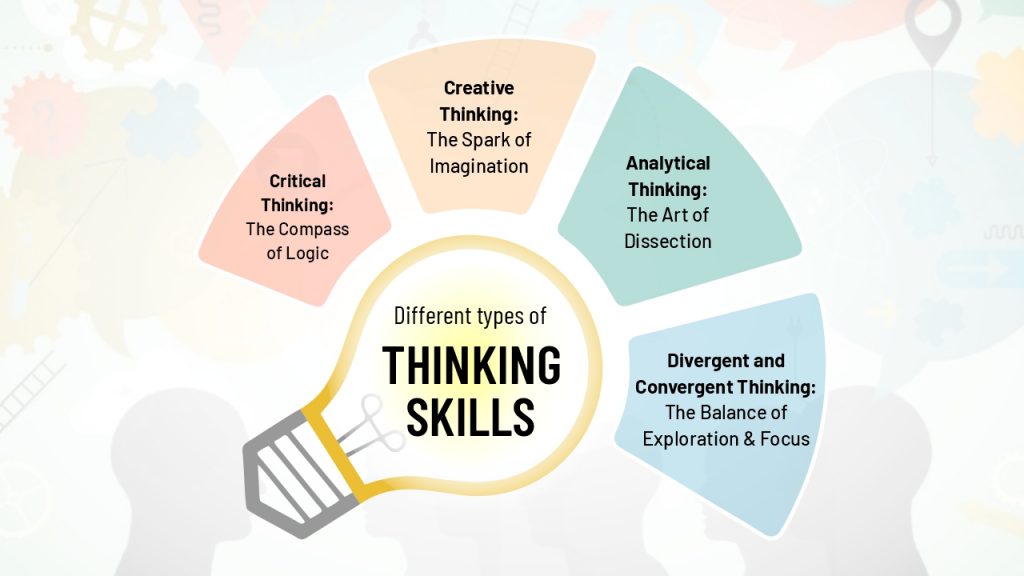
Critical Thinking: The Compass of Logic
Critical thinking is often seen as the foundation of all other thinking skills. It’s the ability to evaluate information, assess the credibility of sources, and weigh evidence before making a decision. Like a compass in the wilderness, critical thinking guides us, ensuring that we remain grounded in reason rather than being swayed by emotions or bias. It’s what allows us to challenge assumptions and think objectively.
Creative Thinking: The Spark of Imagination
Creative thinking is where innovation lives. It’s the ability to look at problems or situations from new perspectives and come up with ideas that are original and useful. If critical thinking is a compass, then creative thinking is the fire that lights the way in unknown territory. It’s about daring to imagine the impossible and crafting solutions that haven’t been thought of before.
Analytical Thinking: The Art of Dissection
Analytical thinking is about breaking down complex problems into smaller, manageable parts. It’s the skill that allows us to see the big picture by first understanding all the little details. Analytical thinkers are like sculptors, chipping away at a block of marble until the true shape of the problem emerges. This type of thinking helps in fields like science, engineering, and technology, where precision and structure are key.
Divergent and Convergent Thinking: The Balance of Exploration and Focus
Divergent thinking opens up a sea of possibilities. It’s expansive, allowing us to explore many different solutions to a single problem. On the flip side, convergent thinking focuses our attention, helping us narrow down those possibilities to find the best course of action. Both are necessary: divergence for creativity and exploration, convergence for decision-making and implementation.
In truth, every type of thinking skill has its place. Like different instruments in an orchestra, they work in harmony to create a full, beautiful symphony of thought.
The Interplay Between Problem Solving and Thinking Skills
How Thinking Fuels Problem Solving
Thinking is the engine that powers problem solving. It’s through thinking that we understand the problem, generate ideas, and assess solutions. Without strong thinking skills, problem solving becomes a hit-or-miss affair.
The Cognitive Process Behind Effective Problem Solving
Problem solving is a cognitive process that involves both rational thought and creativity. It starts with identifying the issue, analysing potential causes, brainstorming solutions, and finally implementing and evaluating the outcome. Each step demands a unique blend of thinking skills.
Developing Strong Problem Solving Skills
Understanding the Root of Problems
The first step in solving any problem is understanding it fully. It’s tempting to jump straight to solutions, but without fully grasping the nature of the issue, our efforts are often misguided.
Brainstorming Solutions
Once the problem is clear, brainstorming helps generate possible solutions. This is where thinking skills shine—creative thinking to explore new ideas, critical thinking to evaluate them, and analytical thinking to break them down.
Implementing and Testing Solutions
Problem solving doesn’t end with a solution. The real test comes in implementation and seeing how well the solution works in practice. It’s often a trial-and-error process, refining the approach as needed.
How to Strengthen Your Thinking Skills
Thinking is a dynamic process, one that can be refined and sharpened over time. Like muscles in the body, our thinking skills need regular exercise to grow stronger. But how do we strengthen these skills, and why is it so important?
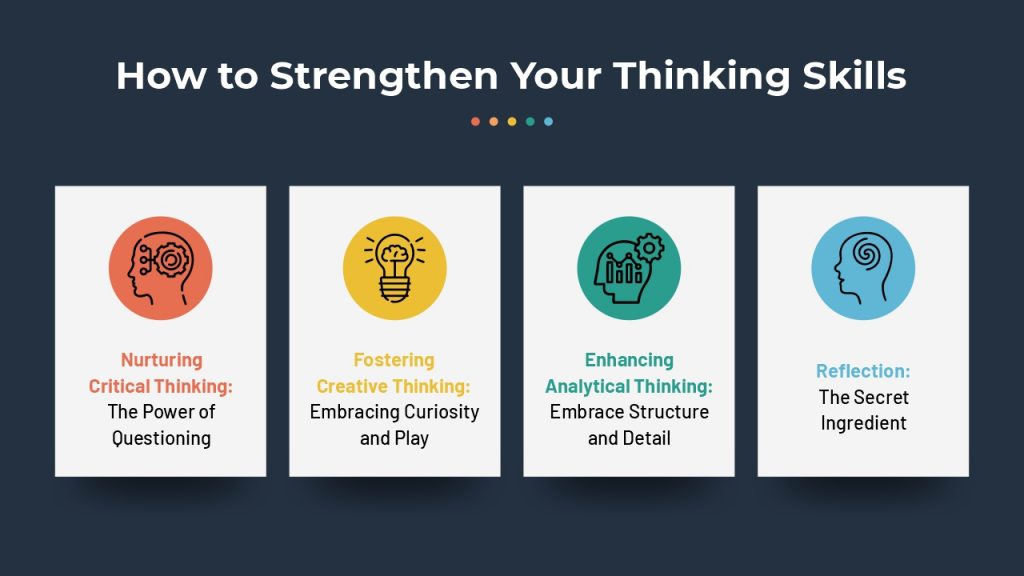
Nurturing Critical Thinking: The Power of Questioning
Critical thinking is built on a foundation of curiosity. It thrives when we question the world around us, when we refuse to accept information at face value. To strengthen critical thinking, we must challenge assumptions and examine evidence. Engage in debates, explore different viewpoints, and, most importantly, practise patience. Critical thinking isn’t about finding the fastest answer, but the most accurate one.
Fostering Creative Thinking: Embracing Curiosity and Play
Creativity often springs from a sense of wonder and playfulness. To enhance creative thinking, embrace curiosity. Try new things, experiment with different ideas, and take risks. The more you allow your mind to wander, the more it will stumble upon unexpected solutions. Journaling, brainstorming sessions, and even daydreaming are all excellent ways to tap into your creative well.
Enhancing Analytical Thinking: Embrace Structure and Detail
Analytical thinking benefits from structure and detail. To strengthen it, practice breaking down complex tasks or problems into smaller steps. Look for patterns, analyse data, and draw connections between seemingly unrelated pieces of information. Think of it as a mental workout—each problem you solve is another rep in your mental gym.
Reflection: The Secret Ingredient
One of the most overlooked ways to strengthen thinking skills is through reflection. Take time to look back on decisions you’ve made, consider what worked and what didn’t, and think about how you approached problems. Reflection allows you to learn from your experiences and refine your thought processes over time.
With consistent practice, thinking becomes more flexible, adaptive, and powerful. Strengthening your thinking skills isn’t just about improving problem solving—it’s about enhancing every aspect of your life.
Problem Solving in Professional Environments
In the fast-paced world of work, problems are inevitable. They come in many shapes and sizes—some small and fleeting, others complex and overwhelming. The ability to solve these problems is one of the most sought-after skills in any professional setting. But what does problem solving look like in a professional environment, and why is it so crucial?
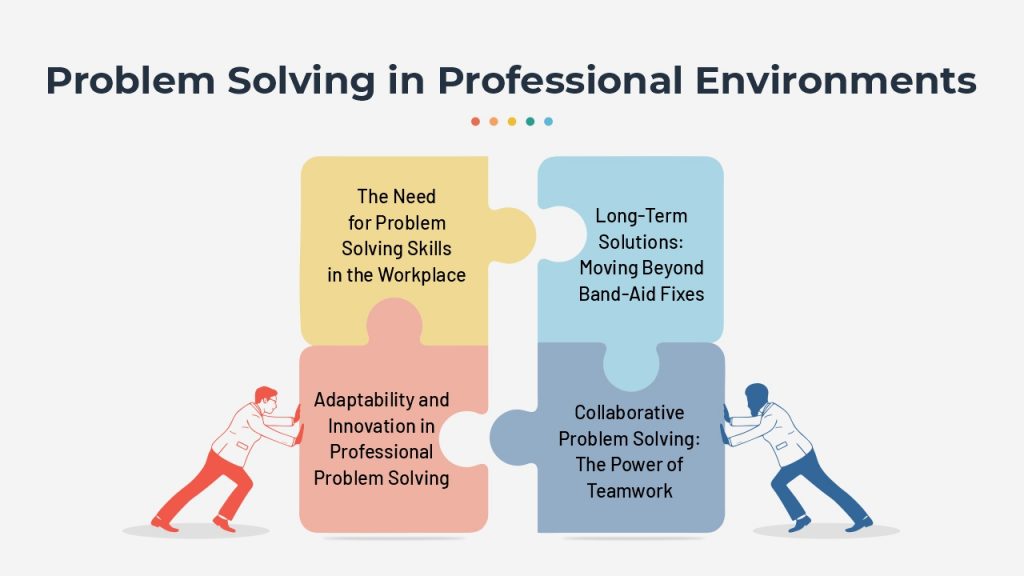
The Need for Problem Solving Skills in the Workplace
Every business, regardless of industry, faces challenges. Whether it’s finding ways to improve efficiency, navigating customer complaints, or handling internal conflicts, problem solving is at the heart of it all. In a professional environment, effective problem solving means more than just coming up with a quick fix. It involves understanding the root of the problem, considering various solutions, and implementing strategies that have long-term benefits.
Collaborative Problem Solving: The Power of Teamwork
One of the key aspects of problem solving in a professional setting is collaboration. Rarely do we solve problems alone in the workplace. Teams come together, each member bringing their unique perspective and expertise. When people pool their thinking skills, the possibilities for innovation multiply. Collaboration is like a jigsaw puzzle—each piece of insight and knowledge helps form the complete picture.
Adaptability and Innovation in Professional Problem Solving
The workplace is constantly evolving, and so too are the problems we face. Adaptability is a critical component of professional problem solving. The best problem solvers are those who can pivot quickly, think creatively, and find innovative solutions that keep pace with the changing landscape. In professional environments, innovation is not a luxury—it’s a necessity. Creative thinking drives new solutions, pushing businesses to stay competitive.
Long-Term Solutions: Moving Beyond Band-Aid Fixes
In professional settings, it’s easy to fall into the trap of seeking immediate fixes for urgent problems. However, real problem solving is about creating sustainable solutions that prevent issues from resurfacing. This requires a combination of analytical thinking, foresight, and strategic planning.
Problem solving in the workplace is a skill that grows with experience. As we face more challenges, our ability to navigate them improves, shaping us into better, more effective professionals.
Thinking Skills in Decision Making
Balancing Emotions with Logic
Decision-making is a balancing act between emotional intelligence and logical thinking. The best decisions often arise when we can weigh both sides carefully, allowing our thinking skills to guide us.
How Structured Thinking Helps in Decision Making
Structured thinking helps break down the complexity of decisions. By following a clear framework, we can avoid biases and make more informed choices.
Common Challenges in Problem Solving
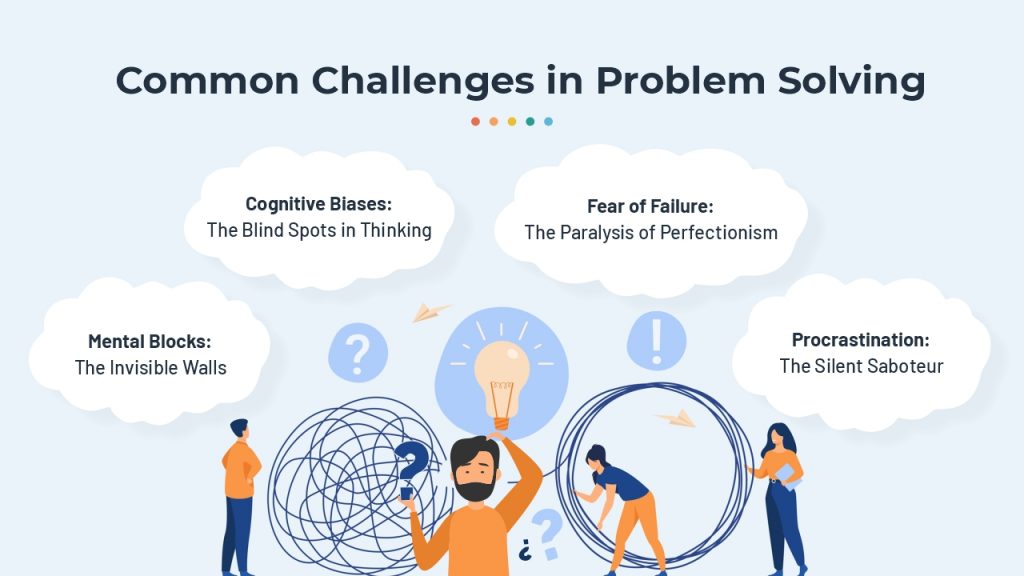
Mental Blocks: The Invisible Walls
One of the most frustrating challenges in problem solving is encountering mental blocks. These are the invisible walls that seem to spring up just when we’re on the verge of a breakthrough. Whether it’s over thinking or being too close to the problem, these blocks can prevent us from seeing the bigger picture. Overcoming them requires stepping back, gaining perspective, and sometimes even taking a break to allow fresh ideas to surface.
Cognitive Biases: The Blind Spots in Thinking
Cognitive biases are another common hurdle in problem solving. These are the unconscious patterns of thought that can lead us astray. Whether it’s confirmation bias (favouring information that supports our preconceptions) or anchoring bias (relying too heavily on the first piece of information we encounter), these biases can limit our ability to think clearly. To overcome them, we need to be aware of their existence and actively challenge our assumptions.
Fear of Failure: The Paralysis of Perfectionism
Fear of failure is a powerful inhibitor in problem solving. When we’re afraid to make mistakes, we often avoid taking action altogether, stuck in a cycle of over-analysis and indecision. The truth is, failure is an inevitable part of the problem solving process. Embracing it as a learning experience allows us to take risks, try new approaches, and ultimately find better solutions.
Procrastination: The Silent Saboteur
Procrastination is perhaps one of the most common challenges in problem solving. When faced with a complex issue, it’s easy to put off tackling it, hoping it will resolve itself or that a last-minute burst of inspiration will save the day. However, procrastination often leads to rushed, subpar solutions. The best way to combat this is to break the problem into smaller, manageable parts and address them step by step.
Ultimately, the challenges we face in problem solving are part of the journey. Overcoming these obstacles requires persistence, adaptability, and a willingness to learn from mistakes. In doing so, we not only solve the problems in front of us but also grow as thinkers and individuals.
Thinking Skills and Innovation
How Creative Thinking Drives Innovation
Innovation thrives on creative thinking. The ability to see beyond the current reality and imagine new possibilities is what fuels progress.
The Role of Divergent Thinking in Inventing Solutions
Divergent thinking opens the door to unconventional solutions, often leading to breakthroughs that convergent thinking alone might not reveal.
FAQs
Conclusion
Problem solving and thinking skills are like two sides of the same coin. Together, they allow us to navigate the complexities of life with confidence and creativity. Whether we are tackling personal challenges or professional dilemmas, honing these skills is essential for growth and success. By practising different forms of thinking and approaching problems with an open mind, we can continuously improve our ability to solve even the most daunting issues.