
Table of Contents
ToggleThe Power of SMART Method Goals: A Path to Success with Real-Life Examples

In life, we all have dreams—those glimmers of hope, ambitions that fill us with purpose. There’s something magical about setting a goal, isn’t there? It feels like planting a seed with the hope that, in time, it will grow into something remarkable. But more often than not, we water that seed with vague wishes and inconsistent efforts, hoping for a flourishing tree without truly nurturing it. We say, “I want to be successful,” or “I want to be happier,” but without the clarity of direction, these aspirations remain suspended in the ether. Without direction, they remain nothing more than vague wishes, lost in the currents of everyday life. Enter the SMART method. The SMART method is like taking those seeds of ambition and planting them in fertile soil, with a clear plan for watering, sunlight, and growth. It turns dreams into a structured path of action, one that is not only purposeful but measurable, tangible, and realistic. The beauty of SMART goals lies in their simplicity and profound impact—they act as a compass that guides us through the maze of distractions and uncertainties toward our true north.
Whether you’re striving for personal development, career advancement, or business success, SMART goals provide the framework to make your ambitions a reality. The path to success is clearer when you know not just where you want to go, but also how, when, and why you’re going there. It’s like taking those dreams, sculpting them, and giving them life with structure and intention. This blog will explore the beauty and practicality of SMART goals, illustrating how they can transform abstract aspirations into tangible realities.
This blog will walk you through the art of setting SMART goals and explore how they can be a transformative tool in your journey, with practical examples that demonstrate their effectiveness in everyday life. Let’s dive into the world of SMART goals—where dreams meet strategy, and aspirations take flight.
What Are SMART Goals?
SMART goals are a framework designed to help individuals set clear, actionable, and attainable goals. The term SMART stands for Specific, Measurable, Achievable, Relevant, and Time-bound. This method not only outlines the goal but also provides a pathway for success, breaking down overwhelming objectives into manageable steps.
The Origins of SMART Method Goals
Behind every achievement, big or small, there lies a plan—a blueprint for turning a vision into reality. The SMART method, a trusted guide for many, was born out of a desire to bring clarity and structure to the sometimes chaotic process of goal setting. But where did this powerful framework come from? What forces shaped it, and how did it become a cornerstone of personal and professional development? The SMART method emerged in the early 1980s, a time when the corporate world was buzzing with new management theories. Businesses were striving to find ways to enhance productivity, accountability, and performance. It was during this period that George T. Doran, a consultant and thinker, crafted the foundation of SMART goals. In his 1981 paper titled “There’s a S.M.A.R.T. Way to Write Management’s Goals and Objectives,” Doran laid out what would become one of the most effective methods for goal setting.
Doran’s intention was simple yet profound: to give goals a backbone. In the corporate environment, many objectives were vague and difficult to measure. Managers would set goals, but their teams often found themselves in a fog, unsure of how to achieve them. Doran believed that goals should be specific, measurable, achievable, relevant, and time-bound—the components that now make up the SMART acronym. This structure gave businesses a way to break down abstract objectives into concrete, actionable steps.
While Doran’s work was initially focused on management, the beauty of the SMART method is its adaptability. It didn’t take long for this approach to spread beyond the corporate world. Educators, life coaches, and individuals seeking personal growth all found value in the simplicity and clarity that SMART goals provided. In a way, SMART goals became a universal language of progress, a method that could be applied to nearly any pursuit.
What makes the SMART method so enduring is its timelessness. Though the corporate landscape has evolved dramatically since the 1980s, the need for structured goals has remained constant. Whether you’re navigating the complexities of modern business, or simply trying to improve your personal well-being, the SMART framework remains as relevant today as it was when Doran first introduced it.
At its heart, the origins of SMART goals are rooted in the idea that we need clarity to move forward. By giving form to our dreams, SMART goals help us carve out a path to success, offering a roadmap for turning visions into reality. And just as this method has evolved over time, so too have the ambitions it helps to realise. In the years to come, as new challenges arise, the timeless principles of SMART goals will undoubtedly continue to guide us toward our most meaningful achievements.
Why the SMART Method Goals Srategy Stands Out
Why is the SMART method so powerful? Because it brings clarity to the chaos of ideas. Many of us set goals, but without a clear structure, we often fall short. SMART goals push us to articulate exactly what we want, how we’ll measure success, and the timeframe for achievement.
How the SMART Method Transforms Dreams into Actionable Plans
Imagine you’re on a journey but don’t have a map. You may eventually get to your destination, but not without some detours and delays. The SMART method is that map. By defining each aspect of your goal in concrete terms, you minimise distractions and maximise efficiency.
The Psychological Impact of SMART Goal Setting
There is something undeniably powerful about setting a goal. It’s not just about the end result—it’s about the journey, the small steps along the way, and the sense of purpose that accompanies each milestone. SMART goal setting doesn’t just guide our actions; it shapes our mindset, fueling our motivation and enhancing our sense of control over the future.
When we set a SMART goal, something clicks in our minds. It’s as if we’ve flicked a switch, telling ourselves, “This is where I’m going, and this is how I’ll get there.” Psychologically, this act of clarity is profound. The human brain is wired for success, but it thrives on direction. When we create goals that are specific, measurable, achievable, relevant, and time-bound, we’re giving our minds the structure they crave.
The first psychological benefit of SMART goals is the sense of focus they provide. When goals are vague, the brain struggles to find a starting point. It’s like trying to complete a puzzle without the picture on the box. SMART goals, on the other hand, give us that picture. We can visualise our objective, break it down into smaller pieces, and work through each step with confidence. This focused effort allows us to channel our energy into what truly matters, minimising distractions along the way.
But the benefits don’t stop there. The measurable nature of SMART goals is key to maintaining motivation. Each small success along the way triggers a release of dopamine—a chemical that reinforces positive behavior and keeps us moving forward. This steady stream of progress feeds our intrinsic motivation, creating a self-sustaining cycle of achievement and reward. The journey becomes just as satisfying as the destination.
Another important psychological impact of SMART goals is the sense of control they offer. In a world full of uncertainties, having control over our goals provides a feeling of empowerment. The achievability aspect of SMART goals ensures that we’re setting realistic expectations, reducing the likelihood of burnout or frustration. When we achieve a goal that we set for ourselves, it reinforces the belief that we have the power to shape our future.
SMART goals also help combat procrastination. By making goals time-bound, we create a sense of urgency that pushes us into action. Deadlines are powerful motivators. They turn “someday” into “today,” forcing us to prioritise and act with intention.
Ultimately, the psychological impact of SMART goals goes beyond simply achieving a task. It’s about cultivating a mindset of growth, resilience, and focus. It’s about tapping into our potential, one specific, measurable, achievable, relevant, and time-bound step at a time. And as we continue to set and accomplish these goals, we’re not just moving closer to success—we’re rewiring our brains for a future filled with purpose and possibility.
Breaking Down SMART Goals
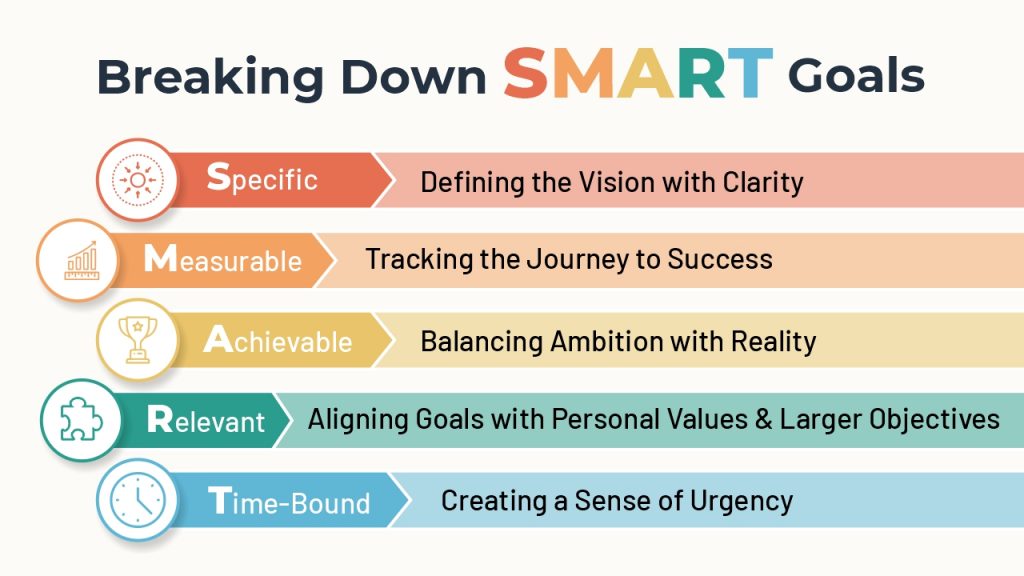
Let’s explore each component of the SMART framework and how it breathes life into your goals.
Specific – Defining the Vision with Clarity
A goal without specifics is like shooting an arrow into the dark. What exactly do you want to achieve? The more specific the goal, the better. For example, instead of saying, “I want to be healthier,” a SMART goal would be, “I will lose 10 pounds by exercising three times a week for the next three months.” The clarity leaves no room for ambiguity.
Measurable – Tracking the Journey to Success
A goal without a way to measure progress is like running a marathon without knowing where the finish line is. For example, if your goal is to save money, the measurable aspect could be “I will save $500 a month.” Measurement is crucial because it shows you how far you’ve come and how far you still need to go.
Achievable – Balancing Ambition with Reality
SMART goals are ambitious, yet grounded in reality. It’s about finding that sweet spot between challenging yourself and setting realistic expectations. If your goal is too easy, you won’t grow. If it’s too difficult, you’ll burn out. A good SMART goal stretches you but remains within your reach.
Relevant – Aligning Goals with Personal Values and Larger Objectives
It’s essential to ensure that your goals align with your broader life objectives. Ask yourself, “Why does this matter to me?” For example, if you’re aiming for a career promotion, ensure it’s in line with your long-term career aspirations. Relevance keeps you focused on what truly matters.
Time-Bound – Creating a Sense of Urgency
Deadlines create accountability. By attaching a timeframe to your goal, you’re creating a sense of urgency. For example, “I want to learn a new language” becomes more actionable when framed as “I will complete a beginner’s course in French within the next six months.”
Why SMART Goals Matter in Different Areas of Life
Life is a journey made up of countless paths, each leading toward a different destination. Whether it’s personal growth, career advancement, or relationship building, we all have dreams and ambitions. But without a clear plan, even the brightest aspirations can fade into the background, lost amid the busyness of daily life. This is where SMART goals come in—offering a beacon of clarity, direction, and purpose.
SMART goals matter because they provide structure to our dreams. Without structure, our goals are like clouds—beautiful, but shapeless and fleeting. A SMART goal transforms those clouds into something tangible, something you can reach out and touch. By breaking down the goal into Specific, Measurable, Achievable, Relevant, and Time-bound steps, the once abstract becomes concrete. No longer is it just a wish; it’s a well-defined plan with a clear path forward.
Let’s begin with personal development—perhaps the most intimate area of life where SMART goals make an impact. Personal growth is a lifelong journey, filled with challenges, discoveries, and transformations. Whether you’re aiming to improve your physical health, cultivate a new skill, or develop mindfulness, SMART goals give you the structure to stay focused. Instead of saying, “I want to be healthier,” a SMART goal might be, “I will run 5 kilometres three times a week for the next three months.” This clear, actionable plan keeps you accountable, making progress visible and rewarding.
In the realm of career advancement, SMART goals serve as stepping stones toward professional success. Careers can often feel like a maze—full of twists, turns, and unexpected obstacles. Without a clear direction, it’s easy to feel lost. But with SMART goals, the fog lifts. A general desire for a promotion becomes “I will complete a certification in my field within six months, dedicating two hours each weekend to study.” Suddenly, your career path is illuminated, and each step feels purposeful and attainable.
But it’s not just individuals who benefit from SMART goals—businesses thrive on them too. In the corporate world, goals are the compass by which success is measured. A company that wants to increase market share needs more than just ambition—it needs a strategy. A business SMART goal might look like, “We will increase our social media engagement by 15% over the next quarter by launching a new content strategy, posting three times a week, and running targeted ads.” This kind of structured goal keeps teams aligned, focused, and driven toward success.
SMART goals also weave their magic in more personal areas of life, like relationships. Although we don’t often think of setting goals in relationships, doing so can enhance communication and connection. Imagine setting a SMART goal with your partner, such as, “We will set aside one hour every Sunday to talk without distractions for the next two months.” This kind of intentionality strengthens bonds, ensuring that relationships grow in a meaningful and focused way.
No matter the area of life, SMART goals matter because they give direction to our efforts. They break down the overwhelming into the manageable, the vague into the specific. And with each goal we set and achieve, we move closer to becoming the person we want to be, living the life we’ve always imagined.
In the end, SMART goals are more than just a method for achieving success—they are a philosophy for living with intention. Whether applied to personal growth, career advancement, or relationships, they offer a roadmap for navigating life’s many journeys, one well-defined step at a time.
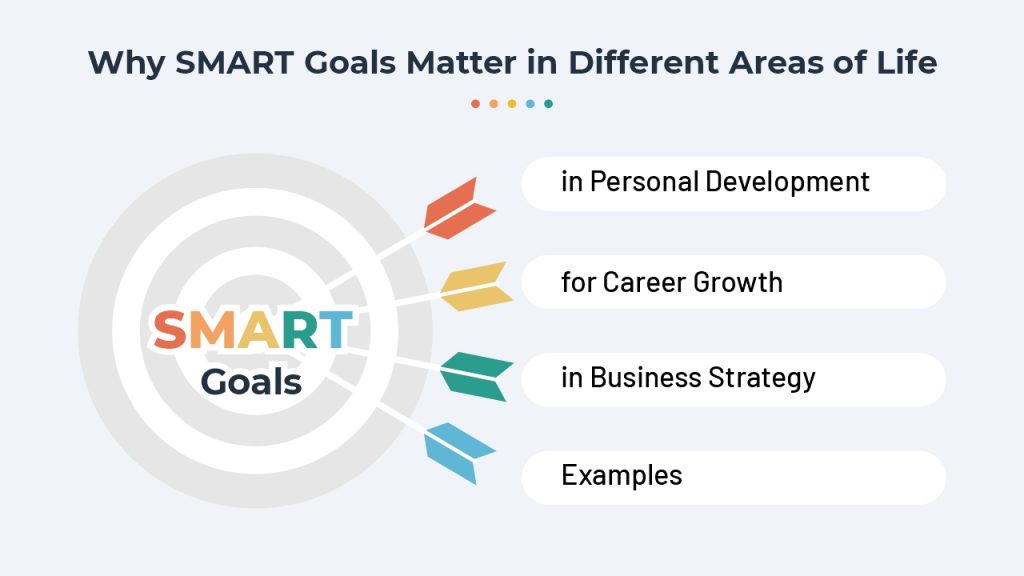
SMART Goals in Personal Development
For personal development, SMART goals offer a roadmap for change. Whether it’s improving your fitness, learning a new skill, or cultivating mindfulness, the SMART method helps to define the steps you need to take to get there.
SMART Goals for Career Growth
Career growth can often feel elusive, but SMART goals break it down. Instead of saying, “I want to advance in my career,” a SMART goal would be, “I will complete a leadership training program within six months to qualify for a managerial role.”
SMART Goals in Business Strategy
Businesses rely heavily on SMART goals to define key performance indicators (KPIs). For example, a company may set a SMART goal to “Increase revenue by 10% in the next quarter by launching a new marketing campaign targeting millennials.”
SMART Goals Examples
Now, let’s look at some practical examples of SMART goals in different areas.
- Personal- “I will read 12 books on personal development this year by reading at least one book per month and setting aside 30 minutes each day for reading.”
- Career- “I will earn a project management certification within the next year by enrolling in an online course and dedicating 5 hours per week to study.”
- Business- “I will reduce customer churn by 15% in the next quarter by implementing a new customer feedback system and offering personalised solutions within 48 hours of receiving feedback.”
Advantages of the SMART Method
SMART goals provide numerous benefits, including a clear roadmap and enhanced motivation.
Clear Roadmap and Direction
SMART goals offer a defined path to follow, eliminating confusion and providing direction. You know what you want, how to get it, and the timeframe you have to achieve it.
Enhanced Motivation and Accountability
By breaking goals down into manageable steps, SMART goals keep you motivated. Each milestone is a small victory that brings you closer to the end result.
Potential Pitfalls of SMART Goals
Despite their many advantages, SMART goals aren’t without challenges.
Over-Planning vs. Execution
Sometimes, we get so caught up in planning that we forget to take action. It’s essential to balance preparation with execution.
The Balance Between Flexibility and Rigidity
While SMART goals provide structure, life is unpredictable. Flexibility is key to adapting goals when necessary, without losing sight of the larger objective.
FAQs
Conclusion
SMART goals have stood the test of time, but they continue to evolve. In today’s fast-paced world, the ability to set clear, actionable goals remains critical. As we move forward, incorporating flexibility and adaptability will only enhance the effectiveness of this method.
